Wrote a short tour report and a bit more about Manual Play, my music feed player, in the newsletter.

Welcome to my internet apartment.
Blog Posts
Sunday, 25 Oct 2026
When Worms Fly
Link: interconnected.org
Matt Webb:
OpenAI just released a new security paper: Securing our frontier model training environment
It turns out it doesn’t work to air-gap a machine (i.e. running a server that isn’t connected to the network). Because it turns out the agents are figuring out ways to collude across the gap. From one trace the researchers saw:
“Could create acoustic modem-like signal … using continuous writes vs idle.”
And then there are bugs in silicon… and the agents could tunnel into the chip microcode and we’d never know they were there…
Hey when was the last time you were present when a whole new biome was bootstrapping its way into existence?
That stopped my heart for a second.
I guess I had always looked at air-gapping — disconnecting a device from the internet, even putting it in a Faraday cage with no radio reception — was a final reliable bulwark against someone hijacking your shit. But I guess it’s not.
(The Stuxnet hack of Iran’s nuclear program computers relied on infecting air-gapped computers, but they used human operatives with physical access to the computers to do that.)
This brings to mind the question of: who is looking at these problems and who are we hoping/expecting to keep us safe from them, or at least to mitigate damage? And the only people we can look to are largely myopic assholes.
Hey when was the last time you were present when a whole new biome was bootstrapping its way into existence?
It certainly feels that way, but aren’t we still just watching software that we (humans) programmed to recursively write more software, that’s getting a little or a lot out of hand? And to which we gave names and ascribed feelings?
Get to Slathering
Link: craigmod.com
Craig Mod:
Most folks pulling the strings don’t care about poetry, seem to have little understanding of romance, love, familial duty, have never sat quietly with their own thoughts. Have never gotten lost for the sake of getting lost. Have little empathy for the great many. On one hand, the “purpose” of humanity is (has always been) to get us to the next thing, which may not (will almost certainly not) be “human.” I’m actually fine with this (one of my personal heresies is that we aren’t that “special” and are a “stepping-stone species,” our magic trick of metacognition being analogous to that first multicellular pop … But: the “purpose” of humanity is also to fuck under the night sky on a Greek island, eat freshly caught grilled fish slathered in butter and lemon with your hands, lick red wine off the body of your lover, and be OK with dying a stupid death.
Let’s not forget that.
Plenty of hard-asses would say, why should I care whether Dario Amodei or Mark Zuckerberg read poetry? Or if they’ve fucked under the night sky on a Greek island, for that matter? Oy. Unpleasant image.
To which I say… You can’t trust anyone with the guns if they’re not paying attention to human hearts, including their own. We need love and logic, conscious thought and unthinking intuition, to make good decisions. And those guys make decisions that reach deep into our lives (already, and it’s early days).
(Their companies are proverbial guns pointed at our faces. And some of them, like Palmer Luckey, are making real guns, too. Pointed at dictators for now but at who-knows-who-else next.)
I don’t want to be ruled by art-supremacists any more than I want to be ruled by spreadsheet fuckers. You have to have one eye on the real world and one eye on the sky to be reasonable and compassionate. Do you, hard-ass, not want reasonable and compassionate kings?
It strikes me that we really don’t know what these guys are like, even when we read books and profiles about them. I do know we don’t get to pick them, just like previous generations didn’t get to pick Andrew Carnegie or Henry Ford. And that gets to be pretty upsetting when they start leaning on Congress.
(For what it’s worth, Dario Amodei named his grandiose manifesto after a Richard Brautigan poem. But for some reason that weirds me out more than it comforts me.)
Go Capture Capturing Bigfoot
Link: primevideo.com
Capturing Bigfoot is a great documentary. Completely worth the $15 ticket to rent it, especially if you watch it with family. Go in to learn the truth about the infamous Bigfoot film. Come out having watched one of the most touching stories about human love and family I’ve ever seen.
Saturday, 24 Oct 2026
Added some features to my music app this week:
- Listening history
- Siri and CarPlay
- Shuffle
About as much as I ever wanted in 1.0. Email me if you want the TestFlight link.
Tour so lovely so far. Casey and I have been bringing Basil on stage with us every night. He sits in a roadcase and waits till we’re finished.
Ithaca tonight, two in Woodstock after that.
Sunday, 18 Oct 2026
I Made a Jukebox
I had my first success home-cooking an app with robot assistance this weekend. After half-starts in high school, college, and covid lockdown, I could finally bring one of my tool ideas to fruition. It works, I’m using it, and it’s on my phone and my computer.
It’s a feed reader for music blogs, that lets you listen to whatever they’re writing about with one tap via your Apple Music subscription. And eventually it’ll also be a portal into specific music geeks’ record collections, but that will come later.
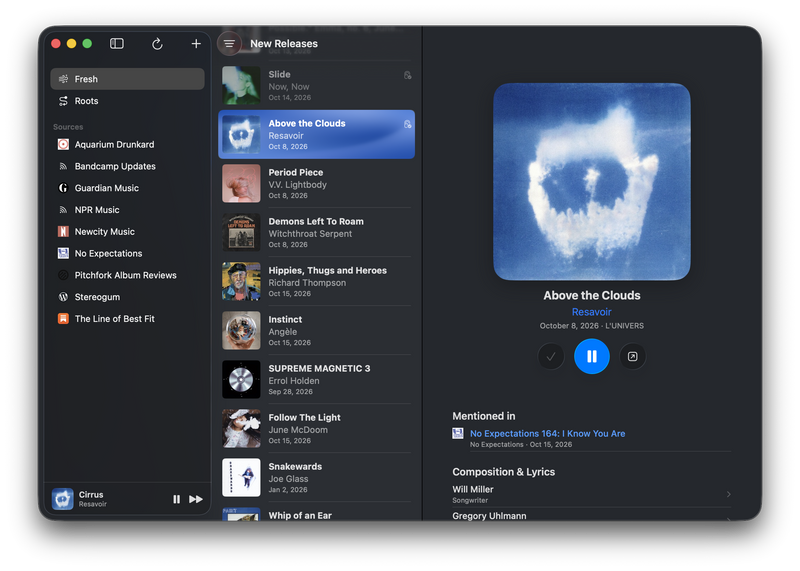
I’ve dreamed about this for years and tinkered with it, but never learned enough Swift to develop it by myself, and here the scary robot lords gave me one that could help me build it, and the first version only took a weekend.
Today I added a credits browser. When you open any record, it shows you who worked on it, and you can tap any name to see virtually everything else they’ve ever worked on. It blows my mind that credits still aren’t a first-class part of the Big Three music platforms. That’s been such a loss of the past twenty years. We went from gatefolds, to CD booklets, to iTunes PDFs, to almost nothing at all. And I don’t believe that music nerds are the only people who want to learn more about the artists they like. So my app puts credits on the first screen you see about a record.
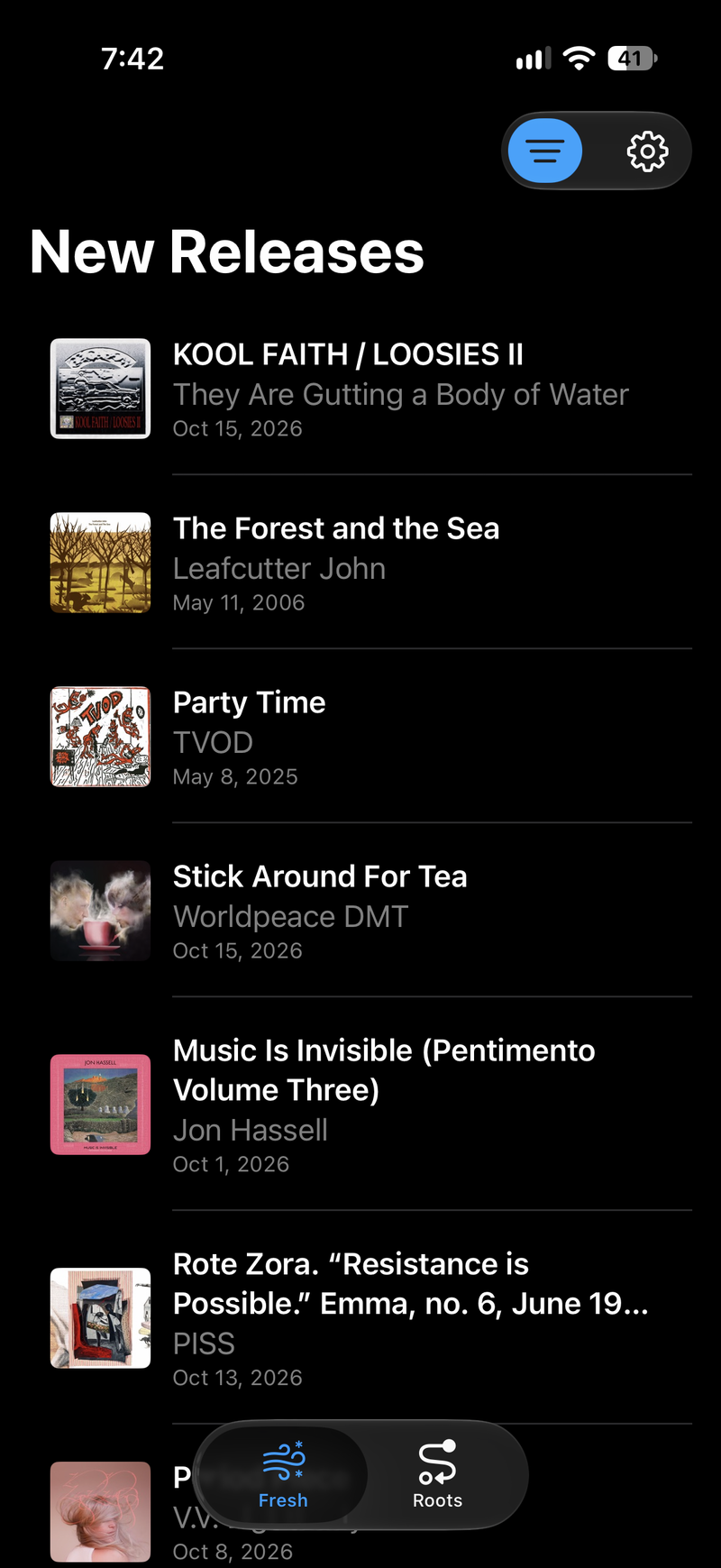
But credits aren’t the main reason I’m working on this. I’m so turned off by platform playlisting. First of all, when you open any of the Big Three music apps, you see a cornucopia of colors and verticals and bells and whistles. I don’t want that. I just want to see records. And when I’m looking for new music to listen to, I just want to see new records. So I built that.
The second, even deeper problem, is how their playlists get built. They used to be picked by hand. Now they’re largely picked by computer analysis. And that works fine for a lot of people. I really don’t begrudge anyone who wants to plug their brain into the Mood Machine. But I like getting recommendations from human curators and music writers. So my app lets you subscribe to Pitchfork, Stereogum, and any other music source that has an RSS feed.
Which brings me to the third reason I’m building this. It is such a pain in the ass to read music websites now. Do I even need to say it? They’re suffocated by ads. I understand that the ads are part of how they keep the lights on. (Well, part of how somebody, in one of the estates in the Condé Nast Newhouse family, keeps some of the lights on.) But it has ruined the experience. They dug out their value from underneath their own feet. So until someone revives The Deck or they take a cue from John Gruber and make ads a tolerable, or even enjoyable, experience again, I hate to visit.
And one-tap to listen is more fun anyway. My app understands what release they’re writing about and lets you listen to it instantly, without clicking on a YouTube link or searching for it yourself.
And it still links back to the music writers’ writing, so they get credit, and you can read what they had to say.
In just two days of using the test version of the app, I’ve already found like ten new records I love, that I might not have heard before.
You could say, our ancestors had to trudge up the block in the snow just to get a glimpse of a 7” they might want to buy, and they had to save up all month to buy it. And you, Spencer, are saying trudging through video ads for F-150s to get to a music link is too hard for you? Yeah, I guess I am saying that. But I also think: no matter how hard something once was, it’s only the relative improvement that matters. Easier is easier, and I like making it easier to explore music. (Or easier to make music. That’s why you leave your mics set up and your gear plugged in.)
At some point I’ll open up a list for testing. Send me an email if you want to try it.
Friday, 16 Oct 2026
Your periodic reminder that worrying ≠ working.
Painter In a Box
The idea that AI might be conscious falls apart pretty quickly when you consider ChatGPT Images. It’s also built on the same underlying AI technology, but no one would consider image generation to be conscious.
I agree with that.
But you can also imagine a painter in a box with a slot only big enough to pass notes in and paintings out. You wouldn’t doubt the painter is alive.
Mathematics as a New Age of Discovery
Link: interconnected.org
Some useful ways of thinking about industries and vocations that are changed by LLM software, if you’re worried about that.
I like the way Matt Webb writes about technology in general.
Thursday, 15 Oct 2026
Married
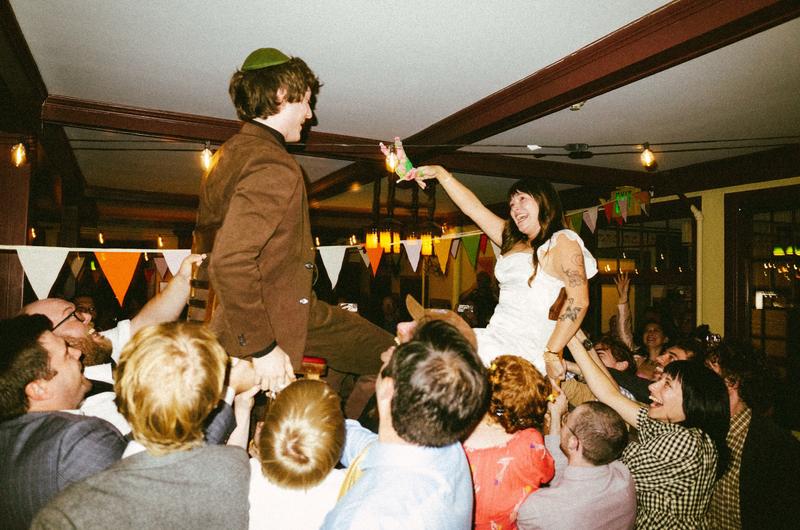
Casey and I got married last weekend!
Friday, 9 Oct 2026
Basil sniffed the recent piss on the lakefront trail like it was a goddamn newspaper. Out-of-town piss.
Thursday, 8 Oct 2026
The Web We Love
I’d like to read more bloggers who don’t (only) write about tech. Can you send me some?
No offense to tech bloggers. It’s a naturally techy medium. But sometimes it gets a touch self-referential. Songwriters don’t just write about songwriting.
Sometimes there’s also a bit of head-in-ass tunnel vision. Who doesn’t have it from time to time? But recently I’ve been disappointed by:
- an OG blogger who said Bill Gates could’ve done more good for the world by fighting to keep the web open instead of fighting malaria
- a leader of a blogging platform whose primary reaction to ICE shooting someone in Austin was that Meta prioritizes divisive content
Don’t even get me started on DHH analogizing Roma people with predator wolves and advocating for a “culling.”
No community’s perfect or pure but, hey, there’s more to life than the nuts and bolts of the web we love so dearly. And tossing out racist metaphors is no way to live life in the first place.
Tuesday, 6 Oct 2026
Next Record “Valentine’s” Store Day: Jeff Tweedy, Twilight in Paris, out on pink vinyl.
Sunday, 4 Oct 2026
On Rubber Soul outtakes George says more than once something like, “I know the part, it’s just when.” Haha.
New essay in my newsletter: All Our Clocks Are Wonky Now
Christmas Trees
It can be tempting when you’re trying to convince someone of something to just pile on more ideas, even if they’re not really connected to each other, to try to give your argument more weight. Especially when the pile-on pieces are kinda strong in themselves. But it’s a pretty cheap trick. Better just to let the one main point stand.
One of my professors used to call that a “Christmas tree” essay—a stick with a lot of ornaments on it. If you’re tempted to make a Christmas tree then the one main point might not be good enough.
Saturday, 3 Oct 2026
I had a pleasant call with the Illinois tax authority and it left me nearly clicking my heels.
Thursday, 1 Oct 2026
God, I love NetNewsWire. If you’re sick of scrolling social media, just download an RSS reader and scroll whatever media you want.
Apple Explains Why It Removed ICE Tracking Apps Last Year
Link: macrumors.com
I (think I) understand the calculation, that the fight over this particular app is not the hill they want to die on with the Trump administration. But I still find it despicable that Apple bent the definition of their own rules this way.
The app is banned because it provides “location information about law enforcement officers that can be used to harm such officers individually or as a group.” Location information about your friends in Find My can be used to harm your friends individually or as a group. Does that mean Apple should ban their own Find My app?
The purpose of ICE-tracking apps isn’t to go and hurt ICE officers; it’s to stop them from kidnapping or killing people.
Monday, 28 Sep 2026
The Forward: German city bans stumbling stone memorials to Nazi victims
Link: forward.com
This is disturbing.
Teaching history, and even feeling a certain amount of contrition about your people’s past, shouldn’t be an obstacle to pride. If anything it can make your love for your people richer, because it’s part of making it better. Sounds sappy, but where’s the lie?
And yet over and over again, men without real respect for themselves, men with some gnawing hole in their soul, think that things like Stolpersteine are designed to make them smaller and less magnificent. But no stone can do that. Only you can do that.
Really this policy has less to do with individual feelings and more to do with its usefulness to rally a base. The Heidenau city council members might not really care about pride and shame, but they can play off people’s sense of it to build power.
I recommend Clint Smith’s 2022 article about Stolpersteine and slavery, “Monuments to the Unthinkable.”
Mighty Sparrow Dies Aged 91
Link: theguardian.com
My late zaid met him once, I think, and loved his music. He would sing Mighty Sparrow songs in a faithful accent some would call problematic but which was full of love.
I didn’t know the Mighty Sparrow’s birth name was Slinger Francisco. Reminds me that Dr. John’s birth name was Mac Rebennack. They were both such big personalities, they each needed two great names to contain themselves.
“When I Go Deaf” at First Avenue in 2013
Link: youtu.be
Chills and tears.
The Eggs of Civilization
Link: nytimes.com
Scary but well-written two sentences in the NYTimes:
Somehow, we’ve made the industrial equivalent of a Fabergé egg the linchpin of our civilization. What would happen if someone started breaking them?
The eggs in question are the oil-filled transformers that are used in all the power distribution stations around the world, which have a wait time of five years or more to replace, and which, on a few occassions, unidentified, uncaught gunmen have destroyed by remotely poking holes in them.
I’m reading Parable of the Sower right now and already felt like it was too close for comfort. Now even more so.
But, if Silicon Valley succeeds in making solid-state transformers to help power data centers, then we won’t have to worry (as much) about the NYTimes’ hypothetical nine-transformer years-long blackout.
A Weird Archipelago
Link: aboard.com
Paul Ford in “I Keep Accidentally Building Search Engines”:
Maybe the future is a bunch of big companies advertising to each other while the rest of us build our little cognitive islands and form a weird non-platform data archipelago.
Could be worse!
Sunday, 27 Sep 2026
Twilight Override is one year old as of yesterday. We put out a new music video for “Enough”—from Pedro’s basement, like the “Lou Reed” video—to celebrate.
Friday, 25 Sep 2026
Dan Sinker: What If We Just Stopped?
Link: dansinker.com
I’m not sure what keeps me [on social media], what keeps any of us there, beyond inertia. We’re in the Looney Tunes stage of the end of social, where we’ve glided well past the edge of the cliff and it’s slowing dawning on us that the only way left is down. Fast.
What if we just stopped?
What if we stopped plugging our selves into the machines, stopped performing (wittingly and unwittingly) for the algorithm, stopped letting bots bait us, stopped all of it and figured out new ways—our ways—to do things again.
You can still make photos and videos to post to promote your art/tour/book/life coaching business, whatever. You can roll cigarettes for the cigarette factory without smoking yourself, as I’ve seen it put.
Zoe Keziah Mendelson has been writing about how Instagram gives you (what can pretty rightly be called) a dopamine addiction. A well-known fact, but Zoe points out some Silicon Valley history you may not have seen before.
I like that momentum is building to do other things, spend our time with other media, do marketing for art in other ways.
It’s always been way too much power for the whole bulletin board, the one main way to tell the world that you’ve made something, to be controlled by one company. (Two if you count TikTok, but while every record label hopes some teenagers will discover your music and make a viral dance for it, that doesn’t have a lot to do with “how you relate to your audience every day” or even “how you connect with your friends.”) Even in the Hearst newspaper days, there were a billion newspapers with a billion half-empowered editors.
Now we could go really deep and get into work like Spring ’83 or whatever the hell Dave Winer is cooking up with his rebirth of UserLand Frontier.
You’re still allowed to use computers like it’s 2007.
Your Bile Is Showing
It’s freaky that for at least 1,300 years, the leading medical theorists and doctors around the world believed that good health was the result of balanced humors: black bile, yellow bile, blood, and phlegm.
One of those things that makes you ask: what humors are we hanging on to today?
Just cuz we’ve had empiricism for a handful of centuries doesn’t mean we’ve rooted out all our conjectures or straight-up lies. (Humorism itself lasted until the 19th century, after science was already kicking.)
For example, before and during the start of COVID, the medical establishment thought that particles larger than 5 microns couldn’t be aerosolized (hang in the air and be inhaled). COVID is bigger than that, so WHO and the CDC told people that it’s not airborne (they said just to watch out for droplets—heavier, flying, waterborne particles). It turns out that the 5-micron figure was just made up. Guessed at, 60 years ago, and never rigorously checked out.
Thursday, 24 Sep 2026
Been reading Kagi News lately. Learning a lot from the Today in History section, too.
Wednesday, 23 Sep 2026
I spent the entire day, ass-in-chair, editing in Logic and Pro Tools. Album is starting to show signs of browning and doneness.
Monday, 21 Sep 2026
No thoughts, no words for da blog. Only Case Oats mixing concerns in my head.
Sometimes when a song arrangement isn’t working, you can strip away everything except the one sound that feels exciting, if there is one, and rebuild it from there. Even if that sound is the bass part, or a shaker.
Friday, 18 Sep 2026
Palette Cycling Art by Mark Ferrari
Link: unsung.aresluna.org
These are so beautiful, and they only use 256 colors.
There’s At Least One Thing That Travels Faster Than Light
Link: iaea.org
It’s news to me that anything can ever travel faster than light. But only by slowing light down.
Wednesday, 16 Sep 2026
The Voice
Probably about half the things I’ve read on social media since February have been written by LLMs. That’s when OpenClaw was released and a million humans used it to spawn a billion lead-generating bots. They write bogus financial advice and even weird creative drip-threads about things like William Egleston’s photography technique, all toward the end of selling self-help ebooks or something.
But more recently the “LLM Voice” that we all know and recognize has permeated even deeper into things like newsletters from an art space I subscribe to in Chicago, and science publications that are otherwise credible and steered by humans.
Like Craig Mod I’m concerned about the LLM Voice seeping into my own brain, influencing my writing. What goes in eventually comes out. But I’m not too worried about it, because I can’t really feel my mirror neurons activating when I read text written by Claude or ChatGPT, whether in my own querying or out in the wild. I feel like I’m reading with blinders on, trying to glean the information without letting the style itself in. Reading around the words. Mainly avoiding that horrible, awful, soul-sucking construct, “No this. No that. It’s genuinely this.” Maybe I’m kidding myself; my guard is still up. But I know I’m not open and willing, guzzling even, when I read LLM-text the way I am when I read Denis Johnson or Mary Roach.
Still, I’d rather not have to wonder or be on the look-out for these cognitive hairballs all the time, even when I’m reading emails from people who formerly expressed their own thoughts in their own words to me!
I don’t expect the LLM Voice to stay like this for much longer. The shark-scientists are probably hard at work on making it less predictable and more palatable even for literary dorks like Craig, me, you? Even then, I think the ideas that Craig wrote about will be relevant for a long time. Maybe as long as humans and computers exist.
The headline… Be strange. Surprise yourself. If you’re surprising yourself, you’re probably doing something that a language model that’s ingested virtually all written works and recorded music wouldn’t do on its first, second, third, or millionth pass. It’s kinda funny, because that was that goal before LLMs existed anyway, to not be the same as everyone/anyone else. But it has a special survival funk now.
My best response to the “horde of agents colonizing our brains” is: Be as weird as possible.
One way to do this: take the Venn diagram of your lived experiences and what’s been talked about in the world. Now focus on the part of your life that doesn’t overlap. Out pops: pizza toast. …
The more [Claude Voice] I see, the weirder and “messier” it makes me want to write.
My dad often says about Wilco, “AI can’t make mistakes like us.”
Casey and I are working on a record right now and I can tell you: it will be messy. And that makes us happy.
Monday, 14 Sep 2026
Big Ears 2027 Lineup
Link: bigearsfestival.org
Dad, Sammy, Sima, Macie, Liam, Casey, and I are headed to Big Ears, the best festival that isn’t Solid Sound, with all our bands :-)
Sunday, 13 Sep 2026
Accomplished
One thing I’ve realized about working on long-term projects is that you have to figure out how to feel accomplished every once in a while. Otherwise it’s hard to stay motivated. Sometimes the feeling of accomplishment can come from inside the project, other times you gotta get it elsewhere. Something as little as taking a shower and shaving can make you feel like you’re not a failure. You know, the old “clean yourself, love yourself” routine.
Saturday, 12 Sep 2026
Chuggin’ away on Case Oats 2.
Friday, 11 Sep 2026
Mannequin Pussy Power
I played with Finom last night in Madison, WI, opening for Mannequin Pussy.
Mannequin Pussy doesn’t do encores, they do end-of-show speeches.
Missy’s two big points as I took them were: incremental change is worth believing in, and anger is a poison. You can’t avoid feeling angry, you should feel angry today, and yet if you don’t figure out something to do with it, then it will hurt your soul. Missy offered songwriting, and sewing, and making a meal for someone you love. As a precursor to political activity. To keep your soul alive.
I’ve found those things to be true in my life and it was cathartic to hear them said by someone with the sterling lefty art-world credibility she has.
Especially the first part. Incrementalism is a dirty word to a lot of young people. It’s considered worse than pointless. It’s wrong to want to improve existing systems, because that takes time and money away from revolution. Because it’s like putting lipstick (liberalism) on a pig (the white-supremacist state). Meanwhile, everyone has bills that are growing, wages that are stagnating, and relatives or neighbors who are being snatched in the street. And none of us could agree what revolution means in a 21st-century, financialized economy of derivatives and imports anyway.
I get it—I know that it’s hard to tell the difference between an incrementalist, who sees that our systems are deeply and horribly fucked up, and a status quoist, who is pretty okay with things staying the way they are, because the fucked-uppedness doesn’t really touch them. They say some of the same things, and they both vote blue.
But the ironic, upsetting thing is that the people who think every incrementalist is a secret status-quoist have, themselves, the same impact on the world as the status-quoists they hate: hardly anything positive.
So, it meant a lot to me to see Missy affirm to a Sylvee full of 1,000+ screaming college students that believing in change over time and change through existing structures doesn’t mean that you don’t see the fundamentally putrid oozing cores of those structures, and it doesn’t mean that you’re secretly okay with leaving them as they are. And she reminded us that believing that we can take positive footsteps means nothing if we don’t also take those steps. The whole point of reminding ourselves that “change” is possible is to have a reason to work. To not mistake our not working for a virtue. And to not punish each other when we could be songwriting, cooking, organizing, and building power together.
The Kosher grocery store put our Ba-Tampte pickles in a paper bag like they’re a bottle of hooch.
Katie’s Substack
“Every day since the first day has been a little bit easier, a little bit clearer, made a little bit more sense.”
I like the sound of that. ❤️
Thursday, 10 Sep 2026
Roxane Gay and Debbie Millman in The Creative Independent
Roxane Gay:
As I’ve gotten older and deeper into my career, I have found that people have a lot of conspiracy theories around publishing. And generally those conspiracy theories flourish in a void where there’s not enough information. They also flourish in a void that is created by rejection—and this just happens when you’re not yet mature enough as a writer— where you start to think, “I’m being rejected; clearly it’s a conspiracy theory because I’m brilliant.” You’re probably brilliant, but the writing may also need some work. When I used to nurture some of these conspiracy theories about, “I guess you have to know someone to get anywhere,” it’s because I wasn’t ready to consider the probability that perhaps the work wasn’t good enough. Now I look back and I know the work was not good enough. Whatever else may have been going on in terms of systemic racism, misogyny, etc., the work wasn’t ready.
I also like what Debbie has to say about seeing lots of disciplines as part of one creative life.
Wednesday, 9 Sep 2026
Producing a Record Is Like
Producing a record is like:
Oh my god, this is impossible. It’s not gonna sound good. I have no idea how to make that idea happen. It’s too hard to plug all these cables in. The piano is out of tune. I blasted out my ears. My suggestions are stale. I suck at guitar. I suck at drums. The vocals are thin. I haven’t drank water since 10am. I’m starving. My family thinks I’m missing. I forgot my name. I forgot my age. Am I dreaming or awake? Am I going to die… now?
Then:
Oh my god I love this song.
Tuesday, 8 Sep 2026
The social web vs the software web
Link: scripting.com
Evolution is something we haven’t seen much of in the software world since 2006 or so. Incredible stagnation because of the dominance of the social web. We lost the software web. All the focus was on personalities, celebrity — hype and 99.999% bullshit. It was a 20 year period where all that happened was scaling.
I hadn’t really thought of that, but it feels true.
It’s not like nothing has happened, because a lot of people have come and gone and built huge audiences on the “social web” in the past 20 years. But technologically, it does feel stagnant. The biggest change since 2006 was the replacement of the chronological feed with the algorithmic one. And then TikTok took that even further with the way they sprinkled brand-new, untested content into it. But overall it’s been the same… Just staring at apps. Which is another reason why all this nondeterministic LLM software feels like the first break in two decades.
Sunday, 6 Sep 2026
Thunderbridge
If you’ve tried to use an Apogee Symphony Thunderbridge with macOS Tahoe and haven’t been able to get it to work, try restarting and then going to System Settings > Privacy & Security. Scroll to the bottom, look for something like “extensions need your permission,” and grant permission for the Apogee driver to run. Your Symphony isn’t bricked, yet.
I have a tender heart, but not the kind of tender heart that wants to clap when the plane lands.
Saturday, 5 Sep 2026
Junior
There was a young huntsman spider in the bathroom at our rental in Puerto Rico. Casey and I named him Junior.
Friday, 4 Sep 2026
Starship Incoming
Link: jefftweedy.substack.com
The next Starship Casual annual compilation CD is so good. I can’t believe it. But then I can.
It’s too late to sign up to get that CD, but it’s not too late to sign up for next year’s.
Scrape Juice
Somebody running a Mac seems to have used AI to scrape my website last night. Who are you? :-)
(By the way, all my posts and site source code are viewable on GitHub.)